The Dark Arts of Claims Trading: Trade Confirmations
Trade confirmations are meant to secure claim pricing early, but buyers can weaponize them. By omitting deadlines and leveraging strict NY law, buyers create a "free option"—forcing a close if profits rise or walking away if they drop.
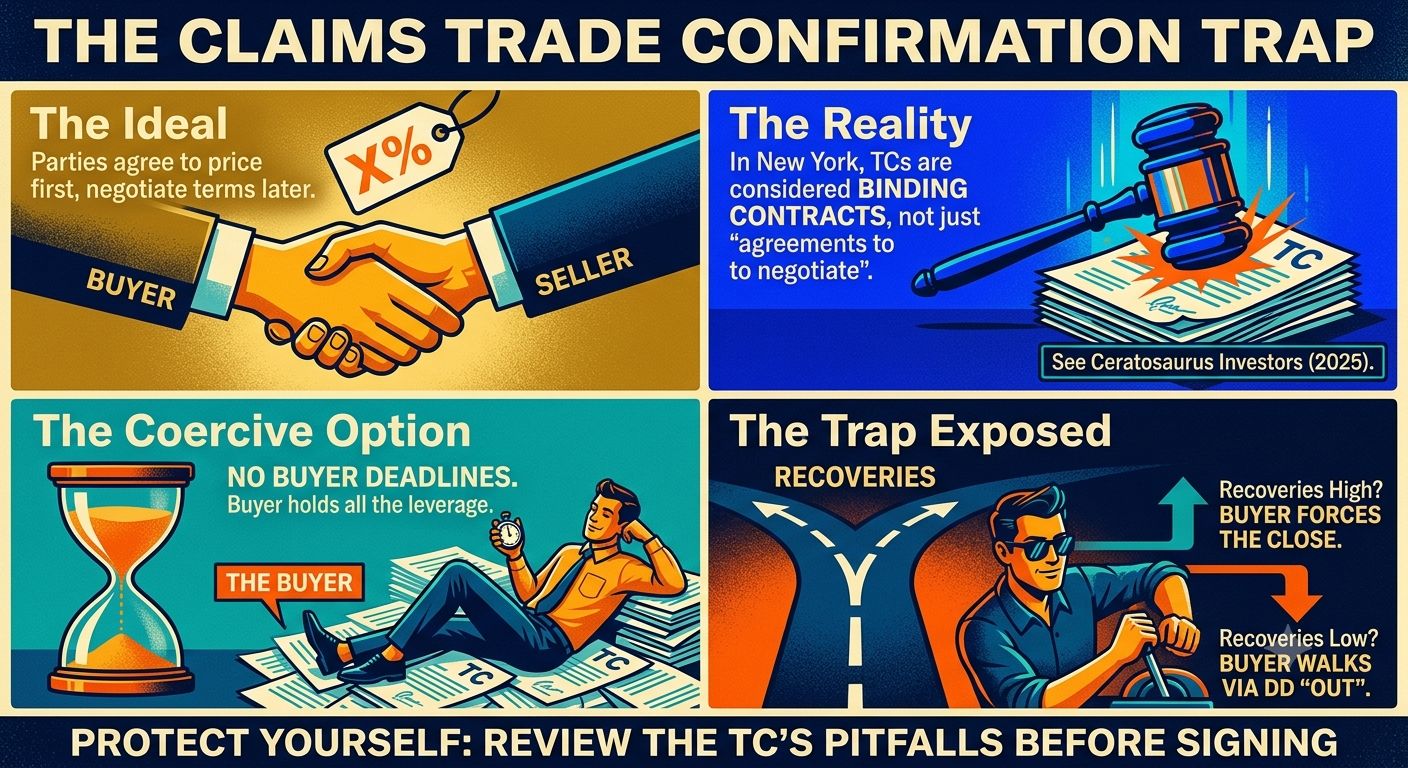
Today we’re talking about a common tactic used in the claims trading world: the trade confirmation (“TC”). In theory, TCs help facilitate fair and transparent claim assignments by allowing the parties to first agree upon a price before negotiating the terms of their definitive assignment agreement. However, in certain instances, buyers have turned this tool into a coercive instrument that gives them a free option to purchase a creditor’s claim purely at their discretion.
A TC is a binding legal document exchanged between counterparties to officially agree on certain parameters of a secondary market transaction before an assignment agreement is negotiated. The most common parameter is price—i.e., “We agree to buy your claim, and you agree to sell it at ‘x’.” Common features of the confirmation include:
- Asset Description: Exact details of the asset being sold, including the name of the debtor/bankrupt company, the specific type of claim, and the reference case number.
- Claim Amount & Purchase Rate: The face value of the claim and the negotiated purchase price (often expressed as a percentage or fraction of the claim’s face value).
- Settlement Details: The due diligence deadline, designated trade date, expected settlement date, and the transfer method (e.g., Assignment vs. Participation).
- Conditions Precedent: Stipulations that the buyer’s obligation to purchase is contingent upon a satisfactory legal and financial due diligence review of the underlying claim documents.
That seems all fine and good, right? Why not take it one step at a time: agree on a price, and then negotiate specific terms?
Well, especially in New York, this mindset severely misrepresents the legal implications of signing a TC. For example, a buyer may present the TC as simply a “memorialization of price” and make the TC’s choice of law New York. The seller assumes they’ve simply agreed on a price, subject to later agreeing on the language of a full assignment agreement. However, New York courts have consistently found that trade confirmations are binding contracts, not simply “agreements to negotiate” (see Ceratosaurus Investors v. B2C Alternative Equity (2025) and Stonehill Capital Mgt. LLC v. Bank of the West (2016)).
Even worse, buyers can structure a TC as a free option should the purchase rate prove to be in-the-money later on in the case. This is done by excluding any buyer deadlines from the TC and making the buyer’s obligation to complete the purchase subject to their sole due diligence satisfaction. In this scenario, the buyer can essentially execute the TC and then just sit on the trade. If down the road it is determined that recoveries on the claims will be higher than the purchase price, the buyer can force the seller to close. If recoveries tank, the buyer can simply walk away via their due diligence “out”—for which they had no deadline to complete.
In its purest form, a TC is a great tool to compartmentalize a claim transfer negotiation and lead to a successful conclusion for all parties involved. However, there are a variety of ways a buyer can turn this tool into a coercive tactic to secure additional benefits that an unsuspecting seller may not notice. Every claimant should be hyper-aware of these potential pitfalls when reviewing an initial confirm.
Get started
Get a quote on your claim
Tell us about your claim and our team will return a fair, confidential quote — typically within 48 hours.
- Email austin@vl-cm.com
- Phone +1 (216) 496-4501
- Schedule: Book a 30-minute call