A PRACTICAL GUIDE TO AVOIDANCE CLAIMS
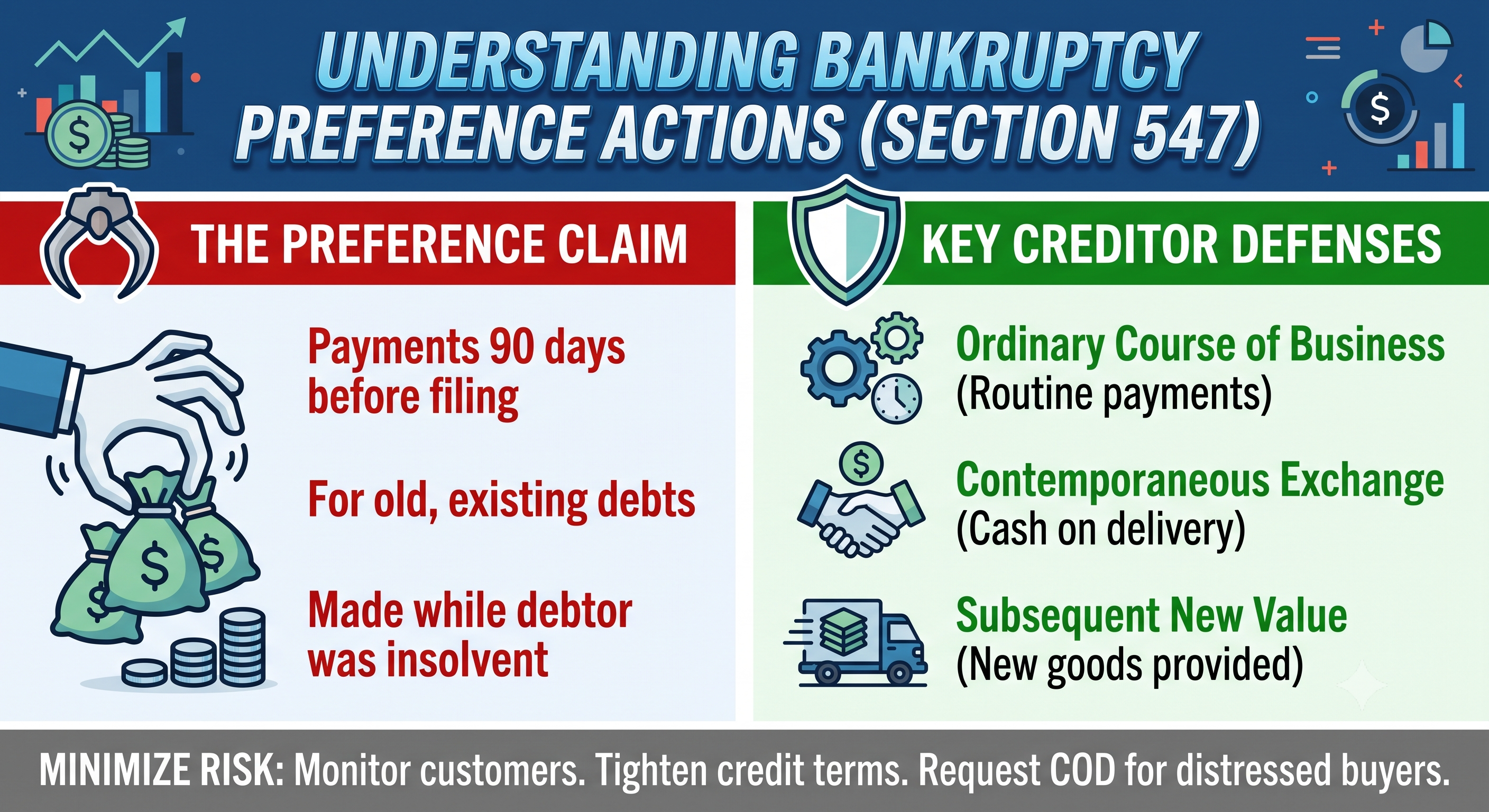
Clawback actions recover pre-bankruptcy payments to ensure equity among creditors. Creditors can defend claims using Ordinary Course, Contemporaneous Exchange (COD), or Subsequent New Value exemptions. Monitor clients to manage risk.
Few things infuriate a vendor more than receiving a preference demand letter. Not only does the debtor owe you money, now they are saying you owe them more!
While they seem unfair and counterintuitive, these “clawback” actions are key provisions of the U.S. Bankruptcy Code. Congress’s goal in crafting them was equity among creditors: Preventing a failing debtor from unfairly favoring certain chosen creditors at the expense of others right before collapsing into bankruptcy.
What is a Preference Claim
Section 547(b) of the bankruptcy code governs preference claims.Pursuant to it, the trustee or debtor-in-possession bears the burden of proving the validity of the preference action. The statutory framework states:
Except as provided in subsections (c) and (i)… the trustee may, based on reasonable due diligence… and taking into account a party’s known or reasonably knowable affirmative defenses… avoid any transfer of an interest of the debtor in property—
(1) to or for the benefit of a creditor;*
(2) for or on account of an antecedent debt owed by the debtor before such transfer was made;*
(3) made while the debtor was insolvent;*
(4) made—*
(A) on or within 90 days before the date of the filing of the petition; or*(B) between 90 days and one year before the filing... if such creditor was an insider.*
Key Concepts
- **Transfer: **Broadly defined under Section 101 to include both monetary payments (cash, checks, wires) and non-monetary transfers (returning inventory, granting security interests).
- **Interest of the Debtor in Property: **The asset transferred must have legally belonged to the debtor’s estate prior to the transfer (per Section 541), rather than being third-party funds.
- **Antecedent Debt: **The payment must be for a debt that was already incurred before the payment occurred (e.g., an outstanding invoice).
- **Presumption of Insolvency: **Under Section 547(f),the debtor is *presumed to be insolvent *during the entire 90 days leading up to the petition date.
Procedural Lifecycle & Defensive Realities
A preference dispute typically follows a standard procedural path, though debtors frequently leverage strategic structural elements to accelerate resolutions:
- **The Demand Letter: **The process nearly always begins out-of-court with a formal demand letter outlining the targeted transfers and requesting immediate repayment.
- **The Adversary Proceeding: **If an out-of-court settlement cannot be reached, the debtor must formalize the claim by filing a lawsuit known as an adversary proceeding. While intimidating, this transition gives creditors full litigation protections, including formal discovery rights to challenge the debtor’s accounting and insolvency assertions. Note: The debtor operates under a strict statute of limitations and has two years from the bankruptcy petition date to initiate these actions.
Strategic Watchpoint: Coercive “Preference Resolution Procedures”
To improve their prospects of out-of-court success, many debtors embed customized “preference resolution procedures” directly into their Chapter 11 plans of reorganization or liquidation. Under the guise of streamlining fair settlements, these procedures often feature highly coercive terms, such as mandatory mediation in remote venues or tight, aggressive reply deadlines. Failure to comply can result in severe penalties, including the automatic reduction or disallowance of the creditor’s undisputed proof of claim.
Statutory Defenses: The Creditor’s Shield
However, all is not lost if you receive a demand letter. Congress also established strict boundaries and statutory defenses to protect routine commerce and encourage vendors to continue doing business with distressed companies.There are three major defenses that creditors can utilize under 547(c):
1. Ordinary Course of Business – The debt was incurred routinely, and payment matches normal standards either subjectively or objectively. Subjective: Historical consistency in average days-to-pay, payment method, and lack of collections efforts. Objective: Conformity with broader industry norms.
2. Contemporaneous Exchange – The parties effected, and intended to effect, an immediate, simultaneous swap of goods/services for new value. Explicit initial intent for a cash transaction (e.g., COD) where payment and value delivery occur closely in fact.
3. Subsequent New Value – The creditor replenished the debtor’s estate by providing new goods/credit after receiving the preference payment. Linear chronological timeline calculation: Preference Payment → Unpaid New Goods Provided. Reduces liability dollar-for-dollar.
Credit Risk Mitigation: Proactive Protections
Vendors cannot just wait until they receive a demand letter and should instead take active steps to manage receivables and minimize future preference exposure:
- **Continuous Credit Monitoring: **Perform internal credit tracking to detect early signs of operational or liquidity distress in your customer base.
- **Tighten Credit Terms: **If a customer exhibits financial instability, immediately halt the extension of additional open credit lines. Continuing to ship on open account exposes you to increasing risks.
- **Transition to Cash on Delivery (COD): **If the client’s financial situation actively deteriorates, shift exclusively to “Cash on Delivery” or advance wire transfers. By ensuring an intentional, simultaneous exchange, you secure the protection of the Contemporaneous Exchange defense.
Get started
Get a quote on your claim
Tell us about your claim and our team will return a fair, confidential quote — typically within 48 hours.
- Email austin@vl-cm.com
- Phone +1 (216) 496-4501
- Schedule: Book a 30-minute call